Staring at a blank screen while trying to start your thesis is an incredibly frustrating experience for any student. You know you need to find a unique angle, but every idea you have seems completely overdone. It feels like everyone else has already discovered everything, leaving you stuck in a terrible cycle of endless reading. Breaking out of this academic rut is entirely possible if you know where to look.

Instead of spending months drowning in academic journals, you can speed up the process with some clever AI hacks. These intelligent tools act like your personal academic assistants, instantly scanning thousands of papers to find what is missing. By leveraging modern technology, you can move from absolute confusion to that magical “Eureka!” moment in record time. Embracing modern research tools will drastically transform how you approach your studies.

Today, we are going to explore some brilliant ways to find that elusive unique angle for your upcoming paper. You will learn how to easily spot what other researchers missed, saving you countless hours of stress. Get ready to discover the smartest strategies that will finally help you stop procrastinating and start writing. Let us dive into the ultimate guide to identifying your research gap without losing your mind.
The first step in any successful project is understanding exactly what has already been thoroughly studied and published. You cannot figure out what is missing until you have a solid grasp of the current academic landscape. Using advanced text analysis, you can quickly build a visual map of the most discussed themes in your field. This broad overview helps you immediately spot understanding knowledge gaps in research that are begging to be explored.

Once you have your broad map, these brilliant AI hacks help you zoom in on the ignored territories. The algorithms can easily cross-reference millions of articles to show you exactly which subtopics lack sufficient attention. Instead of guessing, you get a clear, data-driven picture of where the current literature falls completely flat. Spotting these lonely corners of academia is the perfect way to develop unique research topics that stand out.
Visualizing your field saves you from the exhaustion of reading hundreds of irrelevant abstracts one by one. You instantly see the boundaries of current knowledge and the blank spaces waiting for your brilliant contribution. It basically turns a completely overwhelming literature review into a fun, interactive treasure hunt for new ideas. Using these visual mapping techniques is one of the best tricks to manage your thesis without burning out early.

Sometimes, the biggest hurdle is just getting those first few decent ideas down on paper. When your brain is completely fried, prompting a generative model can kickstart your creative thinking process instantly. You can ask the tool to suggest ten unexplored angles related to your general area of interest. This rapid brainstorming phase is crucial for generating fresh research ideas when you feel completely stuck.
Not every idea generated by an algorithm is going to be a golden ticket to academic fame. However, these AI hacks allow you to quickly filter out the weak concepts by asking follow-up analytical questions. You can command the system to evaluate the feasibility of each idea based on current technological limitations. This intelligent filtering ensures you only spend time on ideas with strong potential rather than dead ends.
Once you find a spark of inspiration, you need to mold it into a solid, academic inquiry. The right prompts can help you sharpen a vague concept into a highly specific, answerable scientific problem. You can easily bounce variations back and forth until the wording is absolutely flawless and perfectly targeted. This interactive dialogue is incredibly helpful when you are learning how to formulate research questions effectively.
Many scholars overlook the fact that missing information is just as valuable as the data that actually exists. Sometimes, a field is saturated with theories but desperately lacks empirical evidence to back those claims up. By analyzing recent publications, smart algorithms can pinpoint exactly where empirical evidence is frustratingly scarce. Recognizing these specific shortages helps you in understanding data gaps in research for your upcoming project.
Another powerful way to use AI hacks is to analyze the demographics or variables used in past studies. You might discover that ninety percent of the existing experiments were only conducted on a very specific demographic. Expanding the focus to a previously ignored group is a fantastic, straightforward way to contribute original knowledge. Finding these specific demographic oversights is a classic method for discovering practical gaps in research that need solving.

If everyone in your field uses the exact same surveys, maybe it is time to try something different. You can ask your digital assistant to suggest alternative ways to gather information that others have completely ignored. Perhaps shifting from traditional surveys to observing online digital communities could provide a massive breakthrough in your field. Exploring these alternative routes helps you diversify your data collection methods to capture entirely new insights.
A brilliant way to find a unique angle is to look closely at how previous studies were actually conducted. If an entire field relies heavily on qualitative interviews, introducing a quantitative survey could completely change the game. Smart algorithms can easily summarize the dominant methodologies used in the top fifty papers of your chosen topic. This quick summary allows you to easily spot methodological gaps in research that offer exciting new possibilities.
Sometimes the most groundbreaking discoveries happen when you mix two completely different academic fields together. You can use your favorite AI hacks to suggest methodologies borrowed from psychology to solve a stubborn engineering problem. This cross-pollination of ideas often leads to incredibly innovative study designs that impress your academic supervisors. Designing these blended approaches requires a deep understanding of comprehensive research design frameworks across various disciplines.
Before committing completely to a wild new methodology, you need to ensure it is actually viable and realistic. You can run simulated scenarios through your digital assistant to predict potential flaws in your proposed experimental setup. Identifying these issues early saves you from massive headaches during your actual data gathering and analysis phases. Avoiding these common research design flaws ensures your final project remains robust and highly credible.
Every academic discipline has foundational theories that most scholars simply accept without asking too many difficult questions. One of the best AI hacks is asking the system to play devil’s advocate against these established norms. This aggressive questioning can reveal inconsistencies or outdated assumptions that are ripe for a modern scholarly takedown. Challenging these established ideas is crucial for truly understanding conceptual gaps in research within your specific domain.
Once you tear down an old theory, you have the amazing opportunity to build a brand new one. You can use digital tools to help synthesize conflicting ideas into a unified, coherent new theoretical model. This process of connecting seemingly unrelated concepts is where true academic genius finally gets to shine brightly. Developing these robust structures is a vital part of building strong theoretical frameworks for your thesis.
Sometimes the literature is full of papers that completely contradict each other, leaving readers confused and frustrated. You can command your digital tools to sniff out these glaring inconsistencies across dozens of recent academic publications. Wherever experts violently disagree, there is a massive opportunity for you to step in and find the truth. Highlighting these unresolved arguments is a phenomenal way to justify the importance of your research to your committee.
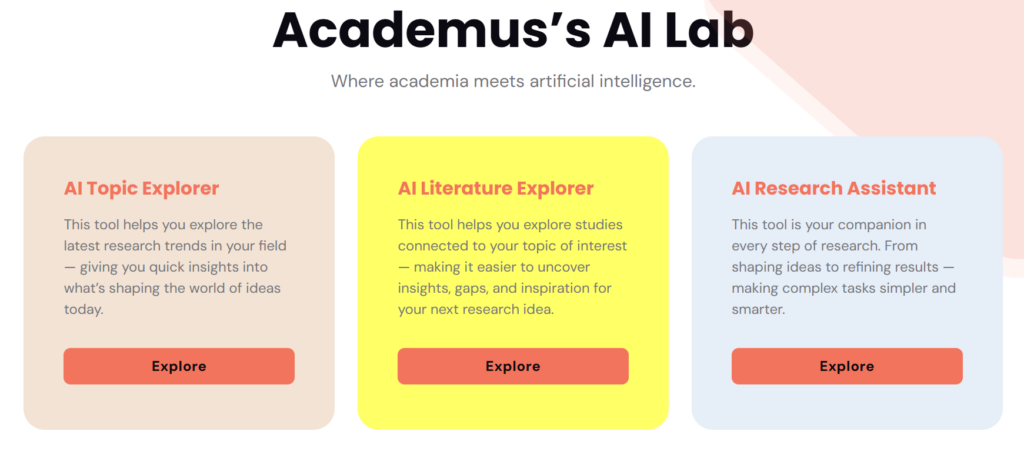
Now that you know exactly what to look for, you need the right platform to execute your grand vision. Researchmate has officially launched an incredible new “AI for Research” module designed specifically for academics. This powerful tool brings the magic of modern artificial intelligence directly into your daily academic workflow. Exploring the Academus AI Lab will fundamentally change how you interact with scholarly literature forever.
Finding your unique angle is amazing, but executing the project often requires a team of dedicated, like-minded scholars. Alongside their brilliant AI hacks, Researchmate offers a dedicated tool to match you with the perfect research partners. You can easily find peers who share your obscure interests and complement your specific methodological skill sets. Choosing the right co-author makes tackling complex, multidisciplinary projects significantly easier and much more enjoyable.
Once you have your groundbreaking topic and your dream team, you need to keep everything perfectly organized. The platform also provides intuitive features to simplify research management, ensuring you never miss a critical deadline again. You can seamlessly transition from brainstorming to assigning concrete tasks to your dedicated research partners on one simple dashboard. Utilizing these comprehensive tools is essential for effective project management in research and avoiding academic burnout.
After nailing down your topic, the intimidating blank page still waits for you to start typing your introduction. Fortunately, these versatile AI hacks can also help you draft detailed outlines based on your newly discovered angle. Having a structured skeleton makes the actual writing process feel much less overwhelming and significantly faster. Leveraging the best AI tools for writing research papers can easily cut your drafting time in half.
Your brilliant ideas deserve to be communicated clearly, without clunky sentences or confusing grammatical errors getting in the way. You can run your drafts through these intelligent systems to enhance clarity, improve flow, and correct annoying typos. This ensures that your academic reviewers focus entirely on your groundbreaking methodology rather than poor sentence structure. Mastering this step is a huge part of excellent scientific writing in research for prestigious journal submissions.
A massive part of justifying your new angle is writing a comprehensive and convincing review of past literature. Smart tools can instantly summarize massive volumes of text, helping you seamlessly synthesize dozens of complex sources quickly. This prevents you from getting bogged down in endless reading and lets you focus on critical analysis instead. An efficient literature review generator can be a total lifesaver during this exhausting phase of your studies.
Finding a unique angle for your thesis does not have to be a miserable, tear-filled experience anymore. By utilizing these powerful AI hacks, you can confidently navigate the massive sea of existing academic literature. You can easily spot the missing pieces, challenge old theories, and uncover entirely new paths for discovery. Embracing these smart study techniques and strategies will undoubtedly make your academic journey much smoother.
Remember that technology is meant to assist your brilliant mind, not completely replace your unique human creativity. These tools are simply incredibly fast research assistants that help you clear away the confusing academic noise. Ultimately, it is your unique perspective that will turn those digital suggestions into actual, groundbreaking academic knowledge. You must always maintain strong academic integrity while navigating these advanced technological shortcuts.
So, stop staring endlessly at that blank document and start taking immediate, proactive action today. Dive into platforms like Researchmate to leverage their incredible suite of intelligent tools designed specifically for modern scholars. Your magical “Eureka!” moment is waiting just around the corner, hidden within the data you have yet to explore. Get out there and finally begin your research like a pro using the power of artificial intelligence.