Artificial intelligence has grown into a cornerstone of how people learn, work, and create. Among the various AI models available, two names often emerge in academic and professional discussions: ChatGPT and Scholar GPT.

At first glance, they may appear to serve similar purposes in which both are AI-powered assistants designed to generate human-like text. However, a closer look reveals their distinct niches and application. This article will explore the 7 key differences between ChatGPT and Scholar GPT, which are often overlooked in mainstream coverage.
ChatGPT, developed by OpenAI, is a general-purpose AI conversational model. Its training data spans diverse sources such as websites, books, social media, dialogues, and open datasets. This broad exposure gives ChatGPT a unique strength: flexibility. It can discuss nearly any topic, from casual conversation to coding, and from brainstorming marketing slogans to summarizing technical reports.

However, its strength is also its limitation. Since ChatGPT was not exclusively trained on peer-reviewed academic material, it may lack precision or the most updated scholarly sources. While it can assist students and researchers with paraphrasing, outlining, or simplifying concepts, it is not designed to replace structured academic search engines or databases.
This distinction becomes critical when we begin to look at the differences between ChatGPT and Scholar GPT, where one thrives in versatility, the other is fine-tuned for academic rigor.
Scholar GPT, a specialized derivative of large language models, is designed to support scholarly work. Unlike ChatGPT, it prioritizes access to peer-reviewed research, academic citations, structured knowledge, and research methodology. Its primary mission is to ensure that outputs are anchored in credible, verifiable, and citable sources.
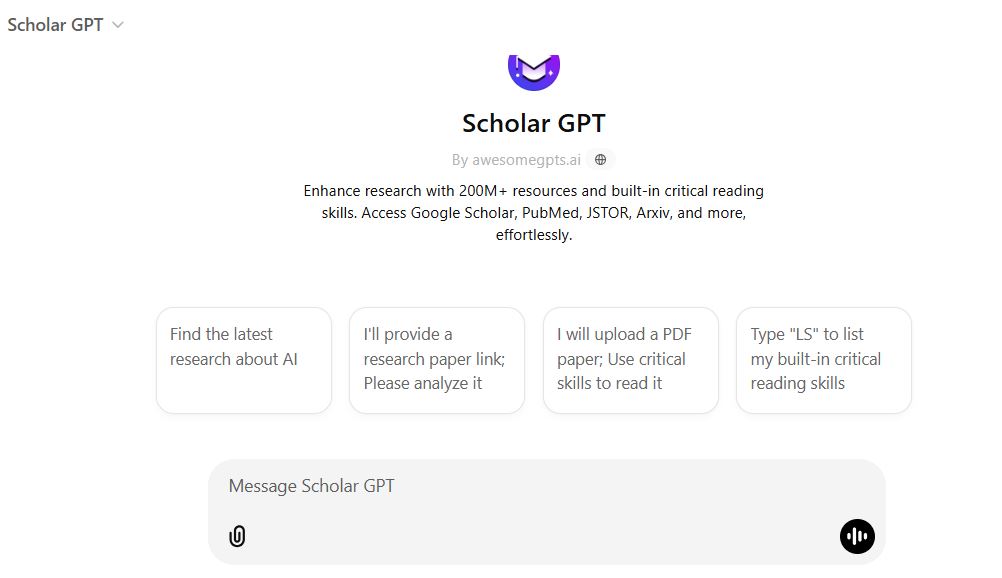
Where ChatGPT may provide a general answer to a question about climate change, Scholar GPT is more likely to deliver structured insights, referencing recent journal articles, databases, or recognized academic frameworks. Its core advantage lies in reducing the time scholars spend sifting through irrelevant material.
This is where the differences between ChatGPT and Scholar GPT emerges most clearly: one is a conversational partner for the general public, the other is a research companion for academics and professionals seeking authoritative content.
One underexplored aspect in the difference between ChatGPT and Scholar GPT is their epistemic values: the underlying ways they prioritize truth, accuracy, and context.
The differences in epistemic values highlights not only what they produce but why they produce it in specific ways.
The differences between ChatGPT and Scholar GPT is also visible in the types of people who use them.

The communities reflect the design priorities: ChatGPT democratizes AI assistance, while Scholar GPT specializes in empowering rigorous inquiry.
A less-discussed differences between ChatGPT and Scholar GPT is how they handle methodology.
ChatGPT excels at conversational flow: summarizing, paraphrasing, brainstorming, or generating creative text that feels natural. It is user-friendly and forgiving, even when asked vague questions.
Scholar GPT, in contrast, assists with methodological rigor. It can suggest research designs, outline statistical frameworks, and guide users toward academic conventions. It is particularly useful in navigating tasks like writing literature reviews, structuring research proposals, or ensuring adherence to APA/MLA formatting.
This methodological edge makes Scholar GPT less entertaining but far more reliable for academic workflows.
Another subtle but important differences between ChatGPT and Scholar GPT is in tool integration.
These integrations make Scholar GPT more specialized but also narrower in its scope.
Another often-ignored differences between ChatGPT and Scholar GPT lies in ethics.
ChatGPT’s risks include misinformation, over-reliance on AI for decision-making, and casual plagiarism. Scholar GPT faces a different ethical challenge: citation misuse. If users rely blindly on its suggested references without cross-verification, it could perpetuate inaccuracies in academic publishing.
Therefore, while ChatGPT users must cultivate digital literacy, Scholar GPT users must emphasize academic integrity. Both require awareness, but the stakes differ. When using AI to write, consider the ethics of AI in research to balance automation with human judgment.
Rather than competing, ChatGPT and Scholar GPT are poised to coexist as complementary tools. ChatGPT will remain the go-to platform for general, creative, and versatile tasks. Scholar GPT, meanwhile, will carve a stable niche within universities, research labs, and professional organizations.
Recognizing the difference between ChatGPT and Scholar GPT allows users to maximize each tool’s potential. Scholars might first use ChatGPT for brainstorming, then Scholar GPT for academic validation. Similarly, non-academics might occasionally consult Scholar GPT when precision is essential, while relying on ChatGPT for daily problem-solving.
The difference between ChatGPT and Scholar GPT is more than just about content sources; it is about values, communities, integrations, and methodologies. ChatGPT embodies accessibility, flexibility, and creative flow. Scholar GPT embodies credibility, rigor, and research orientation.
Understanding these nuances helps individuals choose the right tool for the right purpose. Instead of asking which is “better,” the key is to ask which is “better for this specific task.” In the end, the evolution of AI will not favor one over the other but will expand the spectrum of tools available to meet the diverse needs of human knowledge.